
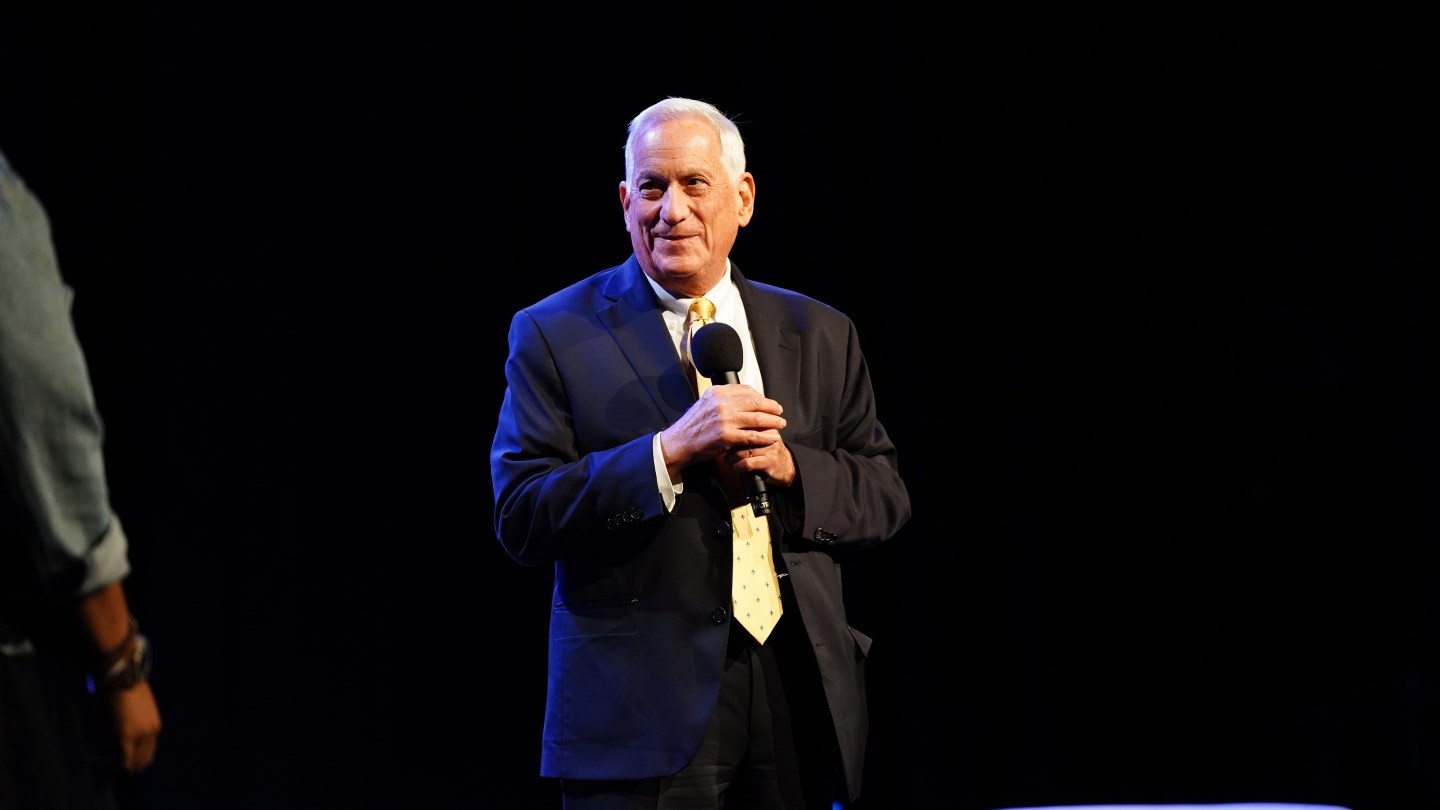
Walter Isaacson, the best-selling biographer of Steve Jobs and Elon Musk, launches a new podcast on Tuesday, Oct. 20, called The Builders with Walter Isaacson, and the first guest is none other than Elon Musk himself.
According to The Hollywood Reporter, the show will run twice weekly into January and feature sit-down interviews with the men and women actually building artificial intelligence: Musk, Palantir co-founder Peter Thiel, Palantir CEO Alex Karp, Anthropic co-founders Dario and Daniela Amodei, AI researcher Fei-Fei Li, and Oculus VR creator Palmer Luckey. Podcast company Kaleidoscope produces the show in partnership with Ramp, with distribution through iHeartPodcasts.
Musk Tells Isaacson AI and Robots Are the Answer to the National Debt
The biggest headline from the Musk episode came early. Axios reported exclusively that Musk told Isaacson, "The only way we're going to solve the national debt is with AI and robots." That is a bold claim from the man who ran point on the Trump administration's efficiency push, and it lines up with his long-standing argument that American innovation, not Washington bureaucracy, is the only force capable of fixing what ails this country.
The national debt sits north of $30 trillion, and career politicians have done nothing but kick the can down the road. If Musk is right, the solution will not come from another spending bill or another blue-ribbon commission. It will come from the builders, the engineers, the people who create rather than regulate.
Why Isaacson Chose a Podcast Over a Book
Isaacson told The Hollywood Reporter that AI moves too fast for the slow machinery of book publishing.
"AI is the most transformative technology we've had maybe since the advent of electricity, 130 years ago, and it's happening so fast that I wanted to get to have a deep dive with the people who are creating it and do it in a more timely manner than a book,"
He also made clear he intends to ask the hard question that establishment media avoids: why are companies building autonomous agents nobody can guarantee they can control?
"I particularly wanted to push back on autonomous agents getting out of control and why are we building them if we're not sure we'll be able to control them,"
That is a fair question, and one the American people deserve answered plainly. Skepticism of concentrated power, whether in Washington or Silicon Valley, is a healthy instinct. It is also squarely in the tradition of the Constitution: no power without checks, no authority without accountability.
Has Elon Musk Changed Since the 2023 Biography?
Isaacson spent two years shadowing Musk for his 2023 biography, and his answer on that question is blunt. The Musk in the book is the Musk of today, he said: a man prone to what Isaacson calls "demon mode," but also capable of great engineering triumphs and imagination.
Isaacson did not sugarcoat the rest.
"Somebody prone to demon mode, also to great engineering triumphs and imagination, and also to having dark conspiratorial political views that I think come from spending too much time wallowing on X as opposed to actually touching grass and getting out there and realizing the world's not such a horrible place."
Love him or hate him, Musk has delivered results that no government program ever has: reusable rockets, mass-market electric vehicles, and a satellite internet network that has kept free communication alive in conflict zones. Merit and output matter more than manners. That is the American way.
Isaacson's Warning: AI Should Serve Humanity, Not Replace It
The most substantive part of Isaacson's thinking goes back to Steve Jobs. In a new introduction to his book The Innovators, Isaacson argues that the personal computer pioneers believed machines should be a "bicycle for the mind," amplifying human creativity rather than replacing human judgment.
The people building autonomous AI agents today, he said, are walking away from that tradition.
"What the people creating agentic autonomous agents are doing is they're getting away from that tradition of making sure we have a tight symbiosis and partnership with our machines, and so I argue we have to go back to the Steve Jobs philosophy of making sure we and the machines are working together to serve humanity."
Even the builders themselves share the worry. Isaacson said that when he spoke with the Amodeis and with Musk, all of them acknowledged the danger and the need for guardrails, self-regulation, or a pause. Yet none will unilaterally disarm in a competitive race. Isaacson compared the moment to the eras of Standard Oil, IBM, and Microsoft, when government eventually had to set rules of the road.
Peter Thiel and the Politics of Technology
Isaacson found his conversation with Peter Thiel especially revealing. Thiel has been demonized by the left, Isaacson noted, while Thiel himself has been busy with his own talk about the Antichrist. The interview left Isaacson with a sober observation: America's technology has become polarizing and divisive at the same time it pushes the country forward, because the brilliance and the darkness of the builders gets baked into what they build.
That is worth remembering the next time a politician promises that a panel of experts in Washington can simply "manage" AI. The technology reflects the people who make it, which is exactly why a free society needs more builders and fewer gatekeepers.
What Happens Next
The Builders with Walter Isaacson premieres Oct. 20 with the Musk episode. New episodes follow twice weekly through January, and Isaacson will keep taping interviews through the fall. He has also confirmed he will continue writing biographies alongside his podcast work, including his earlier On Musk series with Kaleidoscope.
For readers who want a break from the AI arms race and a look at what happens when Washington meddles with the software on your own desk, see our report on