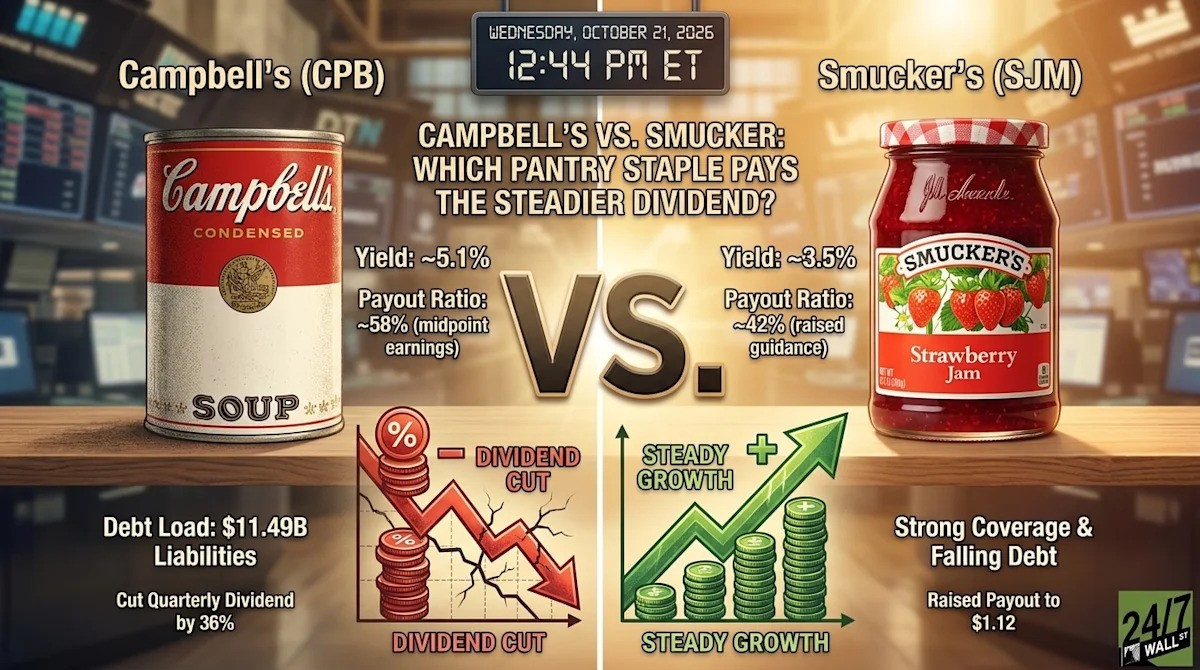
Campbell's cut its quarterly dividend 36% on September 3, 2026, dropping the payout from $0.39 to $0.25 per share, while J.M. Smucker raised its dividend and lifted its fiscal 2027 outlook, according to Yahoo! Finance.
The move redraws the map for income investors, especially retirees who put their savings into household names and expect those names to keep their promises. One company paid its shareholders first. The other paid its lenders.
Campbell's Pays the Bankers, Not the Shareholders
The cut leaves Campbell's (NASDAQ:CPB) with a forward annual payout of $1 per share. At $19.69, that is a yield of about 5.1%. Smucker (NYSE:SJM) pays $4.48 forward at $127.91, good for roughly 3.5%.
On raw income, Campbell's still wins. But that fat yield was the warning sign all along. Back in May, Jim Cramer flagged Campbell's 7.56% yield and told viewers plainly: “People, you don't get those kinds of deals unless people are worried that the dividend will need to be cut.” 24/7 Wall St. reported that the high yield telegraphed the cut months in advance.
When a company borrows too much, the dividend is the first thing on the chopping block. Campbell's chose to pay down debt faster, and shareholders got the haircut. That is the old story of leverage, and it never ends well for the little guy holding the stock.
The Numbers Behind the Cut
Campbell's guided fiscal 2027 adjusted earnings to $1.65 to $1.80 per share, down from $2.17. Even the reduced dividend eats about 58% of midpoint earnings. The company carries $11.49 billion in total liabilities against $3.85 billion of equity. Interest expense is set to rise about $25 million from the La Regina acquisition, and a $500 million bond comes due in March.
Operating cash flow fell 8.13% to $1.039 billion, and management expects a “fairly sharp decline” in first-quarter earnings. The company's own guidance calls for adjusted EBIT to fall between 12% and 7% this year. Campbell's CEO admitted “our performance is not where it needs to be.”
The stock tells the story. Campbell's is down 32.5% over one year and 47.24% over ten years.
Smucker Earns Its Payout the Old-Fashioned Way
Smucker went the other direction. It raised its quarterly payout to $1.12 in July, then lifted its fiscal 2027 guidance to $10.50 to $11.00 per share after quarterly results beat expectations. That guidance covers the dividend at about 42% of earnings.
The company raised its free cash flow target to roughly $1.1 billion and hit a three-times leverage ratio in the first quarter while working toward about $500 million of debt paydown this year. Coffee, which grew 13%, and Uncrustables are funding the payout. Smucker's CEO said the company is “increasing our net sales, adjusted earnings per share, and free cash flow outlook for the fiscal year.”
The track record is straight out of the American playbook. Smucker's quarterly dividend has climbed from $0.15 in 1999 to $1.12, with no reduction in the regular payout in more than 25 years. Campbell's held flat at $0.39 for seven quarters before the cut, and its history shows an earlier reduction in 2001, from $0.225 to $0.1575.
The market has rendered its verdict. Smucker stock is up 26.36% over one year and 35.12% over ten.
What Investors Are Paying For
The two stocks trade at similar valuations, about 11 times earnings for Campbell's and 12 for Smucker, according to AOL. Investors pay almost nothing extra for Smucker's better coverage and cleaner balance sheet.
There are risks on Smucker's side. Coffee prices swing, inflation runs in the mid-single digits, and guidance includes a $0.60 per share net benefit from tariff refunds that will not repeat next year.
Campbell's still appeals to contrarian income investors chasing that 5.1% yield who can stomach a turnaround. The next tests are the March bond refinancing, where management is “strongly considering” a hybrid security, and whether the Snacks division steadies.
For Smucker, the questions are whether buybacks begin and whether coffee momentum holds once the tariff refunds roll off.
FAQ
Why did Campbell's cut its dividend?
Campbell's cut its quarterly dividend 36% to $0.25 per share on September 3, 2026, in order to pay down debt faster.
Which stock pays the higher yield now?
Campbell's yields about 5.1% at $19.69, versus roughly 3.5% for Smucker at $127.91. The higher yield carries higher risk.
Which company has the better dividend history?
Smucker has raised its payout from $0.15 in 1999 to $1.12 with no reductions, while Campbell's has cut twice since 2001.
What happens next for Campbell's?
A $500 million bond comes due in March, and management is strongly considering a hybrid security to refinance it.